
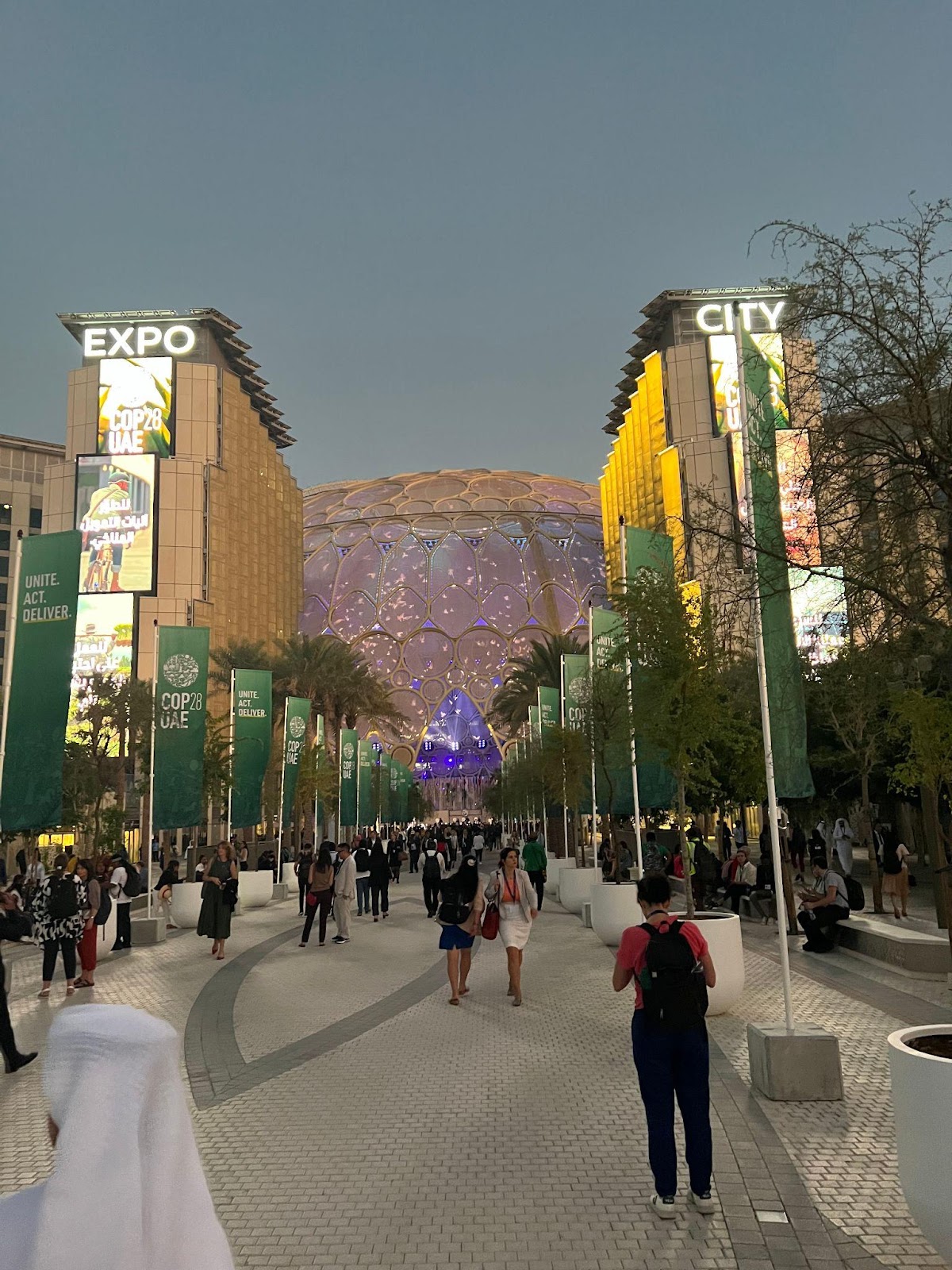
A Special Ethnographic Collection on the United Nations Framework Convention on Climate Change (UNFCCC), 28th session of the Conference of the Parties (COP 28).
By Emily Hite (Saint Louis University), Bea Addis (Washington University in Saint Louis), and Annikki Herranen-Tabibi (Harvard University).

One of the distinguishing features of sociocultural anthropology is a commitment to extensive participant observation fieldwork – a fluid methodological approach that incorporates a spectrum of modalities for participation and observation in the context of our ethnographic interlocutors’ and their communities’ daily lives. We understand other cultures, make connections, and decipher peoples’ worldviews through a reflection of ourselves and our own positionalities. In large part, in this series we do this in order to have a more comprehensive understanding of what influences peoples’ decisions, actions, and behaviors, specifically their relationships with the environment and responses to climate change.
Increasingly, anthropologists and, more broadly, qualitative social scientists, are conducting research under the assumed role of “Observer” at the United Nations Framework Convention on Climate Change (UNFCCC) annual Conference of Parties (COP) conferences. Observers are one of three categories of representatives at UNFCCC meetings, attending alongside the media and Parties to the Convention.
UNFCCC-designated Observer organizations, including the American Anthropological Association (AAA), encompass an extraordinary diversity of representatives from academia, civil society, NGOs, industry, and governments. The UNFCCC allots a small number of badges to each organization, which are then dispersed to their members for use across the two-week COP meeting. In our case, AAA members interested in attending COP28 were invited to register their interest in a badge and were then selected via a transparent and equitable process managed by the Climate Change Interest Group.
As Observers, authors in this collaborative collection utilized their badges to access the blue zone of COP– the spaces where the official policy negotiations and Observer-led side events occur. We take lessons from these experiences and offer critical social science insights into diverse methodological strategies, research foci, and theoretical understandings of climate governance and its processes. While our writings focus on COP28 in Dubai, United Arab Emirates, our observations draw on multiple years of observations in UNFCCC spaces.
Therefore, in COP spaces, we wear multiple hats—we are not only conducting various forms of ethnography, we are also a designated “Observer” there, playing a role in the COP process itself. With attendance increasing each year, COP meetings are massive, chaotic spaces often described as spectacles. To effectively work within COPs, and understand the breadth of interactions occurring simultaneously across large spatial contexts, challenges our traditional notions of the sole ethnographer in a single “fieldsite.” Many authors in this collection work together, in a form of collaborative event ethnography, following in the footsteps of social scientists who study processes of conservation and biodiversity governance. For this group, we had meetings before, during, and after COP28 to discuss our research aims, methods, findings, and to debrief after the exhaustion of the meeting itself subsided.
The essays in this collection interrogate how we, as participant observers in the worlds of climate governance, encounter the institutionalized category of “Observer” within the UNFCCC COP process? What parallels and divergences emerge among anthropological approaches to participant observation and our status as UNFCCC Observers at COP28? What questions and modes of knowledge production appear particularly significant within our observations?
Through two groups of essays, this collection delves into a diversity of topics of concern to social scientists, political ecologists, humanists, and climate change scholars and practitioners. Essays present key ethnographic assessments that are frequently missing from negotiated texts, media outlets, and greenwashed discourses and offer insider insights into expansive sites of inquiry, including some core challenges of climate change governance.
The first group of essays focus on common and overlapping themes of frontiers, nature, and technology, with key insider perspectives of Nature-based solutions and Rights of Nature as well as critical understandings of the technophilic, neoliberal governance of carbon mitigation, storage, and other approaches that shape our futures. The second group of essays (coming soon -June 2024) focus on topics related to social movements, health, and belonging, with ethnographic assessment of the roles of faith-based organizations as well as a spirit-based approach to research, the climate-health nexus, effectiveness of the just transition, the complexities of climate temporality, and varied forms of activism.
This special series was first peer-reviewed by the COP 28 Collective, a group of scholars engaged in collaborative event ethnography. It was edited by Engagement’s editors Lucero Radonic, Sydney Giacalone, and Ángela Castillo.
First Installment
Leaders, Victims, and Fugitives at COP 28
by Emily B. Hite, Assistant Professor, Saint Louis University
“Nature-Based Solutions” to the Climate Conundrum: The Good, the Bad, and the Ugly
by Katie Foster, Postdoctoral Researcher, University of Georgia
Natural Laboratories and the Geographies of Climate Change Technologies
by Emilia Groupp, Stanford University
by Beatriz Lima Ribeiro, Indiana University Bloomington
How Does COP28 Produce the Future?
by Bea Addis, Washington University in Saint Louis & Samara Brock, Yale University
Second Installment
COP City and the Caribbean Climate Masquerade
by Ryan Cecil Jobson, The University of Chicago
The ‘Spectacle’ of Youth Participation at COP 28
by Mark Ortiz, the Pennsylvania State University
Evidence and Experience at the Climate-Health Nexus
by Annikki Herranen-Tabibi, Harvard Medical School
“Do We Still Belong There?” Interfaith Climate Organizations’ Critical Engagement at COP28
by Sarah Hautzinger, Professor of Anthropology, Colorado College
Observing the Just Transition: From Colombia to COP28
by Emma Banks, Bucknell University
by Cristóbal Emilfork, University of California, Davis
Spiritual Engagement in Climate Governance: Lessons from COP 28
by Veronica Bayiha ñwa Quillien, The Language Attitude Institute
Carbon Capture and Storage Emerging as a Major Climate Solution at COP28
by Ajmal Khan A.T, National Law University of India and Harvard University
