
By Melisa Escosteguy (Non-Conventional Energy Research Institute-INENCO-CONICET, Universidad de Salta) and Maria Labourt (Department of Sociology, University of Southern California).
Transformations of an unconventional water body: From brine to lithium
Water worlds are necessarily changing water worlds (Ballestero, 2019b). In the Puna region of the high Andes of Argentina, millenary water bodies and traditional livelihoods organized around them are experiencing varying degrees of disruption due to numerous lithium mining projects. As the world shifts toward forms of green energy, decarbonization goals and practices put environmental pressures on this area, since its underground water is rich in critical minerals.
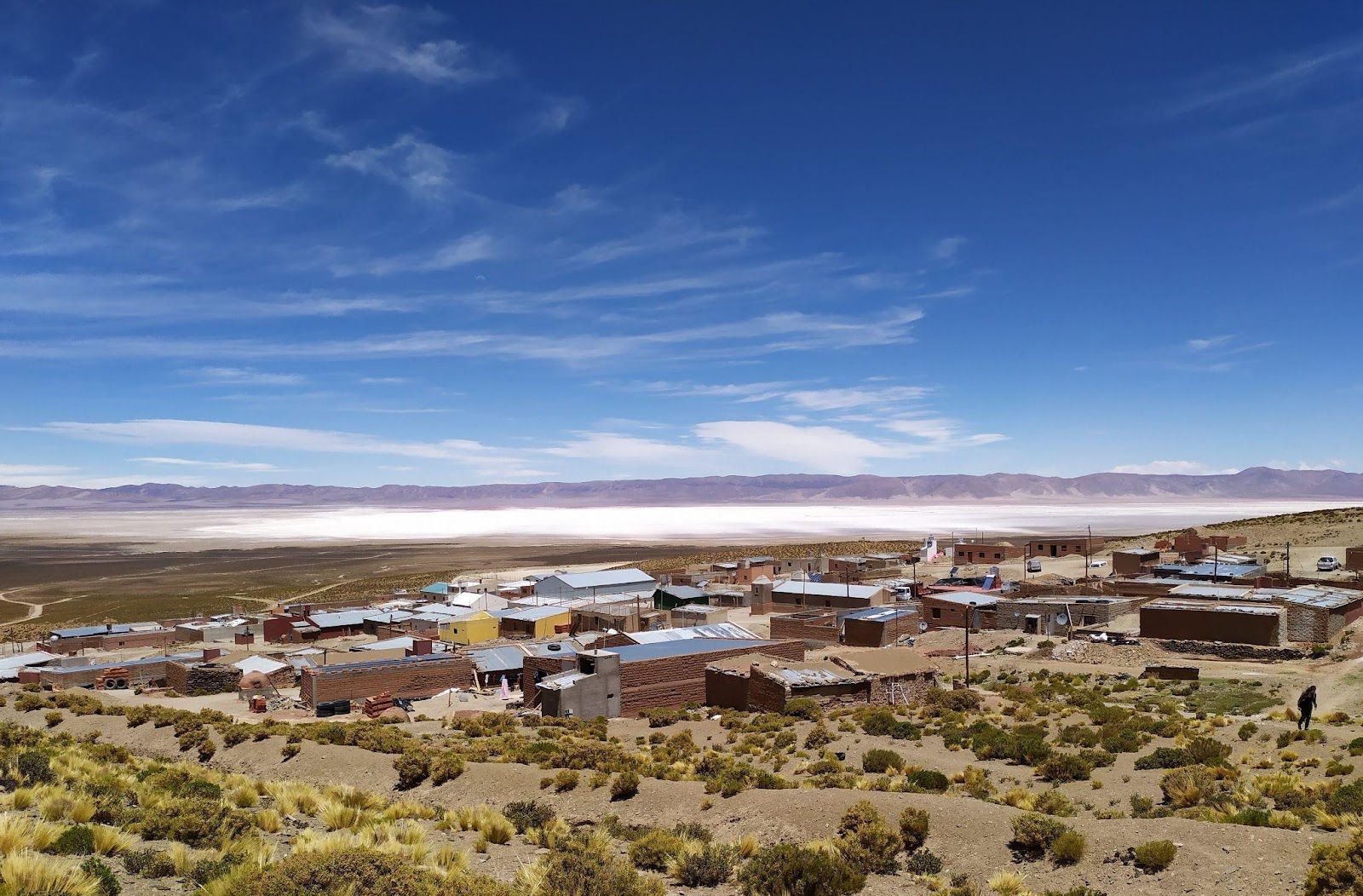
The Puna is a plateau located in the Northwest of Argentina at an altitude varying between 3,000 and 5,500 meters (9,800 to 18,000 feet) above sea level. The dusty flat extensions encircled by distant Andean mountains are known for their high radiation values and low rainfall. Over millions of years, the aridity of the environment, tectonic movements, the presence of mountains and volcanoes, and the occurrence of endorheic basins led to the formation of lagoons that later dried up, giving rise to salars (or salt flats). Salars are then the result of the accumulation of chemical elements washed down from the mountain slopes by rainfall. Among these elements is lithium, a key metal for energy storage.
We aim to explore the many lives of water in Argentina’s upper Andes, from ancestral reservoirs hidden underneath the Puna to a coveted commodity mediated by techno-political devices (or from saltwater aquifers to lithium carbonate). Taking readers on a ride along and beyond the Argentine Puna (Puna hereafter), we ask: How are these water worlds being disturbed (Tsing, 2015)? We focus on two stages of lithium mining -brine pumping and metals concentration- and reflect on the devices and forms of measuring required to transform underground brine into a crucial commodity for a greener future.

We argue that brine mining is singularly relevant for environmental anthropology in general, and for the anthropology of water in particular since it allows some innovative moves. Namely, to denaturalize what counts as water (Ballestero, 2019b) and to complicate these assumptions by addressing the sociotechnical mediations that transform the water bodies under study. Firstly, our focus on ancestral deposits of brine constitutes a turn to thinking through water in an unconventional form: invisible spongy underground formations where water constantly trespasses versatile borders (Ballestero, 2018; Castillo Ardila, 2021). Secondly, the devices that are necessary to convert deposits of saline water (unfit for consumption, irrigation, or industrial purposes) into the white gold of a decarbonized future have the political power to act on concrete sites of intervention and to create the preconditions of a future history of the Puna.
The Argentinian Puna as an Ever-Changing Waterscape
Despite the fact that the discourses mobilized by transnational companies and national and provincial governments try to define the Puna in terms of its resources -by referring to it as the “Lithium Triangle”, for instance- it is not all about lithium in the Puna. For centuries, the Puna has been home to indigenous communities. Shaping and shaped by watercourses, these communities have subsisted through pastoralism, raising animals, such as llamas, goats, and sheep, and through small-scale agriculture. The potato, a plant of American origin, is grown there and is an essential food in every home. Quinoa is a cereal that has been planted since ancient times in small plots of the Puna and uqa (in Quechua) is a native tuber that is also grown in the Puna.
The landlocked rivers that drain into different lagoons and salt flats paint the terracotta color of the endless Puna with green threads. These watercourses, in addition to providing fresh water for the communities’ consumption, allow for pastures growth: thin oasis of modest height grass that fade into the dry soil of the desert only a couple of meters at each side of the riverbanks are the main source of food for livestock and wild species in the area. Precisely, the livestock’s route changes according to the seasons to ensure the availability of water and pastures even in winter when some watercourses freeze. Between June and August, winters are harsh and some autumn and spring nights also reach temperatures below 0 degrees Celsius (32 Fahrenheit). Historically, the indigenous families of the Puna have moved following water movements and flows, usually having two outposts (locally named posts).

While pastoralism is still a significant activity, many indigenous people now work in mining or provide services to mining companies. In some areas, numerous residents have supported the expansion of lithium mining as they highly value employment opportunities in a context where there are almost no job options in the formal sector. However, while governments assert that the development of the lithium industry could be the solution to deeply rooted socio-economic problems (Barandiaran, 2019), affected communities have argued that mining activities often fail to fulfill their needs, expectations, and worries. In fact, there are still many local concerns related to environmental issues and, particularly, the concern about water availability in the region is strong.
Brine Pumping: Dark and Liquid Underworlds
In the Argentine Puna, lithium is extracted from underground saltwater, which coexists with freshwater reservoirs. Brine can be located up to 350 meters (1,150 feet) underneath a salt layer and enters the production process thanks to the job of geologists, engineers and technicians who study the geophysical properties of the salar, build, and operate the mining infrastructure. Central to this infrastructure are the wells through which brine is pumped to the surface and the salmueroductos -brine-pipeline made of a fairly flexible yet very resistant dark gray material- that conduct the brine to gigantic evaporation pools. With the help of the strong winds and radiation of the Puna -and some creative shortcuts workers have crafted- the water contained in the brine evaporates in a process that lasts between 12 and 18 months.
In order to start this process, above a hidden and hard-to-generalize underworld, hydrogeologists working with the mining companies are set to calculate how much brine is viable to extract without negatively affecting extraction and the salar ecosystem. These calculations are presented in a hydrological balance, an immaterial device that estimates the inflows to the aquifer system and the exploitation outflows (García et al., 2021). Once presented to public authorities, they analyze these and eventually make them available as public information. Despite the extreme technicality of these balances, in our experience, experts make it sound like a simple zero-sum equation:
“When one declares a balance, one tells the authorities: everything that rains in the mountains evaporates in the salt flat, that is the key to balance.” (Expert A, interview)
Not only is water a notoriously difficult substance to measure accurately (Muehlmann, 2012), but also the ancient history of brine complex systems makes these measurements seem necessarily partial. In fact, some academics have serious doubts about the data produced by companies and are vocal about the difficulty of knowing the numerous variables at hand (Diaz Paz et al., 2022; García et al., 2021; Marconi et al., 2022). One of our expert interlocutors told us that, at best, companies have models since a rigorous hydrological balance requires historical data not available for the Puna. (Expert B, interview) In this context, a complement to the hydrological data are the simulations carried out by mining companies with a software that predicts the aquifer’s level decrease over time:
“We show the simulated future evolution to the authority: We are going to pump, and we know how much [the aquifer’s water level] will drop every year, and that after 20 years of production, the impact in terms of lowering the level of the aquifer will be X. And when the production is over, a natural recovery process will occur, and we also simulate that.” (Expert A, interview).
However, the hydrological balance report and model simulations are hard to understand by the affected communities. “Although we participate in on-site monitoring, the community does not have a professional who can understand the results.” (Resident C, interview) A resident working at the mine told us that while lithium mining does not use a big amount of freshwater, “a lot of brine is extracted, about 500 litters/second” (Worker D, interview). Therefore, one of the main local concerns is related to a possible lowering of the aquifers’ level.
“Our fear is that the freshwater will compensate for the brine they [mining companies] are extracting, that the freshwater will go to the salt flat so it can be in equilibrium. Think of it this way, if the land is us, the water is the blood [he said this while pointing to his wrist, noting that the water is constantly flowing].” (Resident E, interview).
Much as the veins and arteries in our bodies, aquifers are thought of as liquid flows in constant movement by residents of the Puna. As in other latitudes (Ballestero, 2019a; Brooks, 2017), time and water are narrated as forming a type of equilibrium in its constant flow, searching for compensating disturbance to maintain life as is. Although our informants know that the disturbance created through brine pumping can directly affect their territories and livelihoods, they feel they cannot argue with the technoscientific knowledge generated by the companies. Another resident says that he wants children from his community to become STEMS-trained professionals who would be like translators who speak in technoscientific terms and have traditional knowledge of the lands they inhabit (Resident F, interview). In other words, as Ballestero and Oyarzun suggest, working through concrete devices could open concrete possibilities to challenge systemic and historical dynamics of exclusion and dispossession (2022).

Andrea Ballestero’s work centers on those devices that allow the everyday work of future creation. Hydrological models constitute one of such devices, in that they are shaping both the present and the future materiality of the Puna. Moreover, because “a device is also a conceptual arrangement of contemporary and historical ideas into material forms” (Ballestero, 2019a, p. 194) hydrological balances are techno-political devices. Aimed at delimiting the impacts of brine pumping on aquifers’ levels, these devices legitimate extraction. In performing this quantification and epistemic work, experts are bringing into existence that which cannot be perceived or accurately sized. These devices make countable what for many is not only uncountable but also priceless and may have the political effect of flipping Puna’s water scarcity into a zero-sum balance. In so doing, the limits of how much disturbance is viable before substantially altering an implicit equilibrium may be pushed to a horizon that is hard to accept for affected communities. This is why balances and models have the effect of turning water and brine into a field of dispute where local and techno-scientific knowledge compete and where different visions of the future are not only confronted but also constructed through these technopolitical devices.
Concentration Process: Different Shades of Transparency
In spite of each brine’s uniqueness, the end product -high-quality lithium carbonate- needs to be uniformly pure. How do experts and workers arrive at these standards and which technology assists them? As we will see in exploring the details of the process that starts after declaring hydrological balances, expertise is built out of formal knowledge but mainly out of experience. The almost two-year-long evaporation process aims at increasing the initial concentration of 600 parts of lithium per million (ppm) to 6000 ppm to be industrially processed. It is, certainly, a question of concentration of minerals, but also human focus, physical strength, and sharp measurement tools (experienced human eyes included).
The first workers to meet the extracted brine are those at the primary liming plant, the first destination of the salmueroducto. Usually, no more than three operators and a plant manager are in charge of adding lime (calcium) in order to diminish the magnesium content of the brine. After a rapid operation, brine will be transferred (somewhat automatically) over diverse ponds until a purer lithium concentration is achieved thanks to the action of the wind and the sun. While pipes and pumps allow the automatic flow of brine between ponds, oftentimes this procedure has to be smartly intervened: workers usually install waterproof bags filled with debris if they consider it necessary to reduce the transfer pressure to the next pool (for instance, if expected rain might lower the overall concentration, and brine needs to stay longer in the train of pools). In the long term, some pools will become useless due to the amount of residual mud that has been accumulating. That is when strong men -and a small percentage of women- workers from the surrounding villages build a bypass (a salmueroduct that surrounds and skips the pond) and harvest the residual salt. The harvested salt goes to the cancha (the court) where this environmental liability is converted into an elevated -yet immensely flat- viewpoint from where visitors can admire the installations bursting into the Puna landscape. Different shades of aqua-green ponds can be distinguished from the cancha, each corresponding to a different level of mineral concentration. While from a closer point of view, untrained eyes would not distinguish color differences, workers would estimate the concentration just by taking a quick look from the banks of the pond, usually mistaking the laboratory measurement for a tiny bit.

At the plant stage, workers and experts relate to the brine more abstractly. A plant manager and his/her aids need to stay focused on precisely managed temperatures, agitation systems, and PH levels; and they do so by means of an operating system that allows them to visualize and control all these variables. In addition, valves can be opened and closed, and reagents can be dosed by using the keyboard. In short, this dashboard has all the tools to act on most of the process. Still, although the qualities of the brine are abstracted into figures, experienced workers reserve for themselves a hard-to-translate intuition: One time, an expert-informant (Expert G, interview) was disoriented when an operator warned them: “the pot is going to beat you“. Some hours later, they realized one tank would overflow if no action was taken at the control panel. Only then they understood what the operator had been referring to for a couple of hours before this probable consequence was visible in abstract terms.
The engineers who design these high-scale processes can work with brines that enter the plant with concentrations of over 6000 ppm and would very comfortably achieve the quality goal for the final product. They could also work with concentrations of around 5000 ppm and the process would be unprofitable, but technically viable. The first stage of ponds is carried out, precisely, to enter the plant with a viable and profitable concentration. During processing, there is also a question of balances. Because there are inevitable losses, the higher the concentration the more lithium is lost in the process as well. If the concentration is lower, experts would have to increase the costly reagent. In sum, these balances are less controversial than hydrological ones, but also a delicate task for experts in charge of the plant.
At the end of this long process, concentrated lithium looks like silvery eyeshadow, probably resembling white gold in one of its forms too. While we addressed two of the numerous devices involved, we hope we were able to illustrate how the political and economic life of this coveted substance depends on localized assessments of its hard-to-measure qualities. Quantification of water variables is associated to profitability and commodification. Further, our case presents the intriguing addition of technologies that concentrate one of the components found in saline waters and make that component into a commodity. Devices reorganize meaningful differences (Ballestero & Oyarzun, 2022), and in our case they completely rearrange the difference in brine mineral concentrations. In this process, the many technologies crucial for achieving accurate lithium concentrations reorganize the lives of humans and non-humans of the Puna. All in all, material devices are activated to produce a series of effects on the Puna and beyond, contributing to shape the future of a world organized around extraction and consumption. The future history of lithium and the Puna, though, is yet to be written.
White Gold: Mediated Future Histories
We have addressed the ways in which specific practices of estimating balances and calculating concentrations make saline water underneath the Puna visible, relatable and profitable. As technopolitical devices, hydrological balances and concentration calculations impact the world they operate in. In this sense, the opening question about disturbance becomes a question of transformative encounters. Human-disturbed landscapes such as the Puna are living history, assemblages in the making (Ong & Collier, 2008). To conclude, we would like to briefly touch on the always captivating dimension of temporality that is implicit in these devices’ potential to bring forth possible worlds. One of our informant’s poetic reflections about his opposition to mining is eliciting:
“Some say we are against the future, but […] the future is what my great-grandmother left me.” (Resident E, interview)
By means of sophisticated technologies, brine mining is unearthing geological pasts, disrupting the Puna’s radical presents (Babidge, 2021), and creating unpredictable future histories (Ballestero, 2019a). By focusing on a couple of devices, we have started to critically theorize which substantive effects in the world these may be imparting. In this sense, shifting the temporality focus may help us to keep deepening these reflections: what may technologically mediated brines become in times of Anthropocene? From water to batteries, devices’ concrete effects on the world are meaningful happenings. We, ethnographers, need to pay attention to techno-political devices so as to better grasp imminent futures in the making.
References
Babidge, S. (2021). Seeing water slow resistance and the material enigma of extractive effects on society and ecology [Article]. HAU Journal of Ethnographic Theory, 11(2), 395–411. https://doi.org/10.1086/715788
Ballestero, A. (2018). The Underground as Infrastructure? [Bookitem]. In Infrastructure, Environment, and Life in the Anthropocene (p. 17). Duke University Press. https://doi.org/10.2307/j.ctv121024s.5
Ballestero, A. (2019a). A Future History of Water [Book]. Duke University Press.
Ballestero, A. (2019b). The Anthropology of Water [Article]. Annual Review of Anthropology, 48(1), 405–421. https://doi.org/10.1146/annurev-anthro-102218-011428
Ballestero, A., & Oyarzun, Y. (2022). Devices: A location for feminist analytics and praxis [Article]. Feminist Anthropology (Hoboken, N.J.), 3(2), 227–233. https://doi.org/10.1002/fea2.12108
Barandiaran, J. (2019). Lithium and development imaginaries in Chile, Argentina and Bolivia [Article].
Brooks, E. (2017). Number Narratives: Abundance, Scarcity, and Sustainability in a California Water World [Article]. Science as Culture, 26(1), 32–55. https://doi.org/10.1080/09505431.2016.1223111
Castillo Ardila, Á. (2021). Antropologías de la extracción y lo subterráneo en Colombia . In A. Camargo (Ed.), Antropología y Naturaleza (pp. 15–54). Asociación Colombiana de Antropología.
Diaz Paz, W., Arias Alvarado, P., Salas Barboza, A., Seghezzo, L., & Iribarnegaray, M. (2022). Huella Hídrica como indicador del consumo de agua en la minería del litio en la Puna Argentina. Avances En Energías Renovables y Medio Ambiente, 223–234.
García, R., Kruse, E. E., Etcheverry, R. O., Tessone, O. R., & Moreira, P. (2021). Características hidrogeológicas de los salares en la Puna Argentina. In El litio en la Argentina: Visiones y aportes multidisciplinarios desde la UNLP. Universidad Nacional de La Plata.
Marconi, P., Arengo, F., & Clark, A. (2022). The arid Andean plateau waterscapes and the lithium triangle: flamingos as flagships for conservation of high-altitude wetlands under pressure from mining development [Article]. Wetlands Ecology and Management, 30(4), 827–852. https://doi.org/10.1007/s11273-022-09872-6
Muehlmann, S. (2012). Rhizomes and other uncountables: The malaise of enumeration in Mexico’s Colorado River Delta [Article]. American Ethnologist, 39(2), 339–353. https://doi.org/10.1111/j.1548-1425.2012.01368.x
Ong, A., & Collier, S. J. (2008). Global assemblages (1st ed.) [Book]. Wiley.
Tsing, A. L. (2015). The mushroom at the end of the world: on the possibility of life in capitalist ruins. Princeton University Press.
Melisa Escosteguy is a PhD Candidate in Anthropology at the University of Buenos Aires, Argentina. She is currently doing research on political ecology, sustainability, and lithium production in Northern Argentina.
Maria Labourt is a PhD Candidate in the Department of Sociology at the University of Southern California, United States. Her dissertation research focuses on three technopolitical devices to examine knowledge production around the lithium industry in the Argentine Puna.
Activism (13) Agriculture (19) Climate Change (28) Conservation (33) Environment (29) Environmental Justice (13) India (12) Indigenous People (14) Infrastructure (27) Multi-Species Anthropology (30) Settler Colonialism (15) Socio-Environmental Justice (25) Toxicity (17) United States (35) Water (21)
